
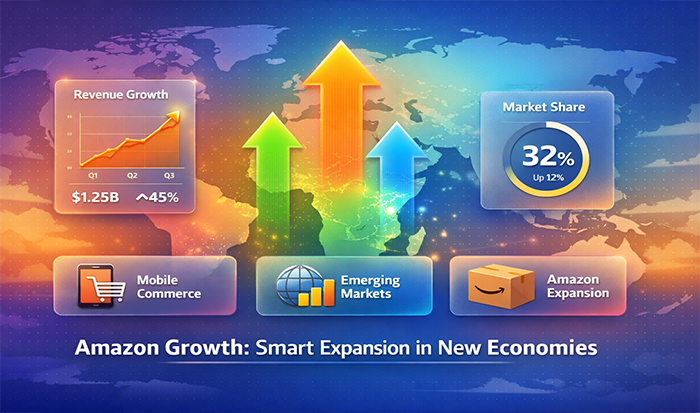
The global economic landscape is undergoing a profound structural transformation. For decades, developed economies in North America and Western Europe served as the primary engines of corporate revenue. However, a combination of market saturation, demographic aging, and slowing growth in Western nations has shifted the corporate gaze toward developing regions. Emerging markets now represent over half of global gross domestic product and are projected to drive the vast majority of worldwide economic expansion over the next decade.
Entering these markets is no longer just a strategy for scaling; it is a necessity for long-term business survival. The combination of expanding industrial production, massive infrastructure investments, and rapidly rising domestic consumption creates an ideal environment for agile companies. Businesses that understand how to navigate the unique dynamics of these regions can unlock unprecedented avenues for growth and value creation.
The Rise of the Connected Consumer and Digital Ecosystems
One of the most compelling growth opportunities in emerging markets stems from a profound demographic shift: a young, digitally native population entering their peak spending years. Unlike developed markets, where digital infrastructure was built gradually over decades, developing nations frequently leapfrog legacy technologies. Millions of consumers transitioned directly from having no telecommunications access to owning high-speed smartphones, bypassing the desktop computer era entirely.
This rapid technological adoption has laid the groundwork for massive digital ecosystems, particularly in fintech and e-commerce. Traditional banking systems in regions like Sub-Saharan Africa, Southeast Asia, and parts of Latin America historically excluded large segments of the population due to strict documentation requirements and lack of physical branches. Today, mobile money platforms and digital wallets have connected hundreds of millions of previously unbanked individuals to the formal financial system.
-
Fintech and Digital Payments: Businesses can capitalize on this by integrating localized payment options into their service models. Companies that build frictionless payment systems tailored to regional mobile networks gain immediate access to a massive pool of ready buyers.
-
E-Commerce Infrastructure: The lack of traditional retail brick-and-mortar stores in rural or secondary cities presents an extraordinary opportunity for e-commerce brands. Growth in this sector requires businesses to invest heavily in hyper-local logistics, localized language interfaces, and decentralized distribution hubs.
-
On-Demand Services: From ride-hailing to grocery delivery, hyper-local applications are transforming daily life in mega-cities across India, Indonesia, and Brazil. Foreign and domestic enterprises alike can capture market share by adapting these services to local cultural nuances and economic realities.
Global Supply Chain Diversification and Manufacturing Hubs
Geopolitical shifts, international trade tensions, and the desire for operational resilience have forced global corporations to rethink their manufacturing strategies. The reliance on a single geographic location for manufacturing proved risky during recent global disruptions. Consequently, industrial diversification has emerged as a massive boon for alternative emerging economies.
A strategy known as near-shoring or friend-shoring is driving billions of dollars in foreign direct investment into countries like Mexico, Vietnam, India, and parts of Central Europe. These nations offer competitive labor costs, highly skilled engineering talent, and favorable trade agreements with major consumer economies.
-
Advanced Industrial Parks: Governments in emerging economies are heavily funding specialized industrial zones equipped with reliable power grids, modern logistics, and tax incentives to attract multinational corporations.
-
Technological Infrastructure: Countries like Taiwan and South Korea have long dominated advanced semiconductor manufacturing. Now, other emerging nations are actively building out hardware production capacities, battery manufacturing plants, and data center facilities to support global artificial intelligence infrastructure.
-
Logistics and Distribution Networks: As supply chains shift, immense opportunities exist for businesses specializing in international freight forwarding, cold-chain storage for pharmaceuticals and agriculture, and last-mile industrial delivery.
Sustainable Infrastructure and the Energy Transition
Emerging markets are disproportionately bearing the operational challenges of climate change and rapid urbanization. At the same time, many developing countries are uniquely positioned to build out green, sustainable infrastructure from scratch rather than retrofitting archaic fossil-fuel systems. The scale of energy transition investments required in Latin America, Asia, and the Middle East represents one of the largest commercial opportunities of the century.
Many emerging nations possess abundant natural resources critical to the green transition, such as lithium, copper, solar irradiation, and vast coastlines ideal for wind energy generation. Governments are actively partnering with private enterprises to modernize public utilities, expand mass transit, and build renewable power grids.
Renewable Energy Generation
The demand for off-grid solar solutions, micro-grids, and utility-scale wind farms is soaring across developing nations. Companies that provide scalable, low-cost renewable energy technology can secure long-term government contracts and establish a permanent foothold in rapidly growing utility sectors.
Smart Urban Mobility
As millions of people migrate to urban centers every year, municipal transport systems face extreme strain. Opportunities abound for enterprises specializing in electric bus fleets, smart traffic management systems, and EV charging infrastructure tailored to dense, chaotic urban layouts.
Waste and Water Management
Rapid industrialization often outpaces public sanitation capabilities. Businesses delivering advanced water purification systems, desalination plants, and industrial recycling technologies find a highly receptive market among both public entities and private industrial operators.
Localizing the Value Proposition for Success
The most common point of failure for established companies entering emerging markets is assuming that a strategy that worked perfectly in New York, London, or Tokyo will succeed unchanged in Mumbai, Nairobi, or Mexico City. This corporate arrogance frequently leads to costly exits. Succeeding in developing economies requires a commitment to deep localization.
Localization goes far beyond translating advertising text into the native language. It requires fundamentally redesigning products, pricing models, and distribution networks to match the purchasing power and daily habits of the local population.
Sachet Marketing and Micro-Pricing
In many emerging markets, consumer income is fluid and distributed daily or weekly rather than in predictable monthly salaries. To capture this demographic, consumer goods giants successfully utilize sachet marketing—selling products in single-use, highly affordable packets rather than large, expensive bottles. Software and service providers can mirror this by offering daily micro-subscriptions or pay-as-you-go models instead of demanding annual upfront contracts.
Embracing the Informal Economy
In many developing countries, the informal economy—consisting of independent street vendors, open-air markets, and neighborhood family-owned kiosks—accounts for the majority of retail sales. Instead of trying to force these consumers into modern supermarkets, successful companies build distribution networks that supply these micro-retailers directly, respecting the established cultural patterns of the community.
Frequently Asked Questions
What are the main indicators that a country is transitioning from a developing nation to an emerging market?
A country transitioning to an emerging market status typically exhibits sustained gross domestic product growth outpacing the global average, rapid urbanization, an expanding middle class with disposable income, and increasing integration into global trade networks. Additionally, the country will show structural improvements in its domestic capital markets, increased foreign direct investment, and regulatory reforms that protect private enterprise and intellectual property.
How can a business accurately assess political and regulatory risk before investing in an emerging economy?
Businesses can evaluate these risks by analyzing local regulatory transparency, historical policy stability, currency convertibility, and the independence of the judicial system. Partnering with local legal counsel, consulting multilateral investment guarantee agencies, and reviewing geopolitical risk indexes help construct a comprehensive risk profile before committing substantial capital to the region.
Why do digital-first businesses scale faster in emerging markets compared to traditional asset-heavy enterprises?
Digital-first businesses scale rapidly because they do not require extensive physical infrastructure, complex local real estate acquisitions, or massive upfront capital expenditures. By utilizing existing mobile smartphone networks and cloud computing, digital enterprises can distribute their services instantly to millions of users across vast geographic distances without facing physical supply chain bottlenecks.
What strategies can companies use to protect their intellectual property in regions with weak enforcement laws?
To safeguard intellectual property, companies should implement strict operational controls, compartmentalize proprietary technology so that no single local entity possesses the entire blueprint, and rely on trade secrets rather than public patent filings where appropriate. Furthermore, forming joint ventures with trusted, politically aligned local partners provides a practical layer of security and localized recourse.
How does currency volatility impact the long-term profitability of foreign investments in developing regions?
Currency volatility can erode nominal profits when local revenues are converted back into a company’s home currency. Sudden devaluations increase the cost of imported raw materials and servicing foreign-denominated debt. Businesses mitigate this financial risk by using financial hedging instruments, sourcing operational inputs locally to match costs with revenues, and reinvesting local profits directly back into the domestic market.
In what ways can micro-financing options accelerate B2B sales for industrial equipment in these territories?
Many small and medium enterprises in emerging markets possess strong business models but lack the upfront capital to purchase modern industrial machinery. Offering embedded asset-backed micro-financing, leasing options, or revenue-share models allows these local businesses to acquire productive equipment immediately. This unlocks sales velocity for the manufacturer while fostering local economic development.


